
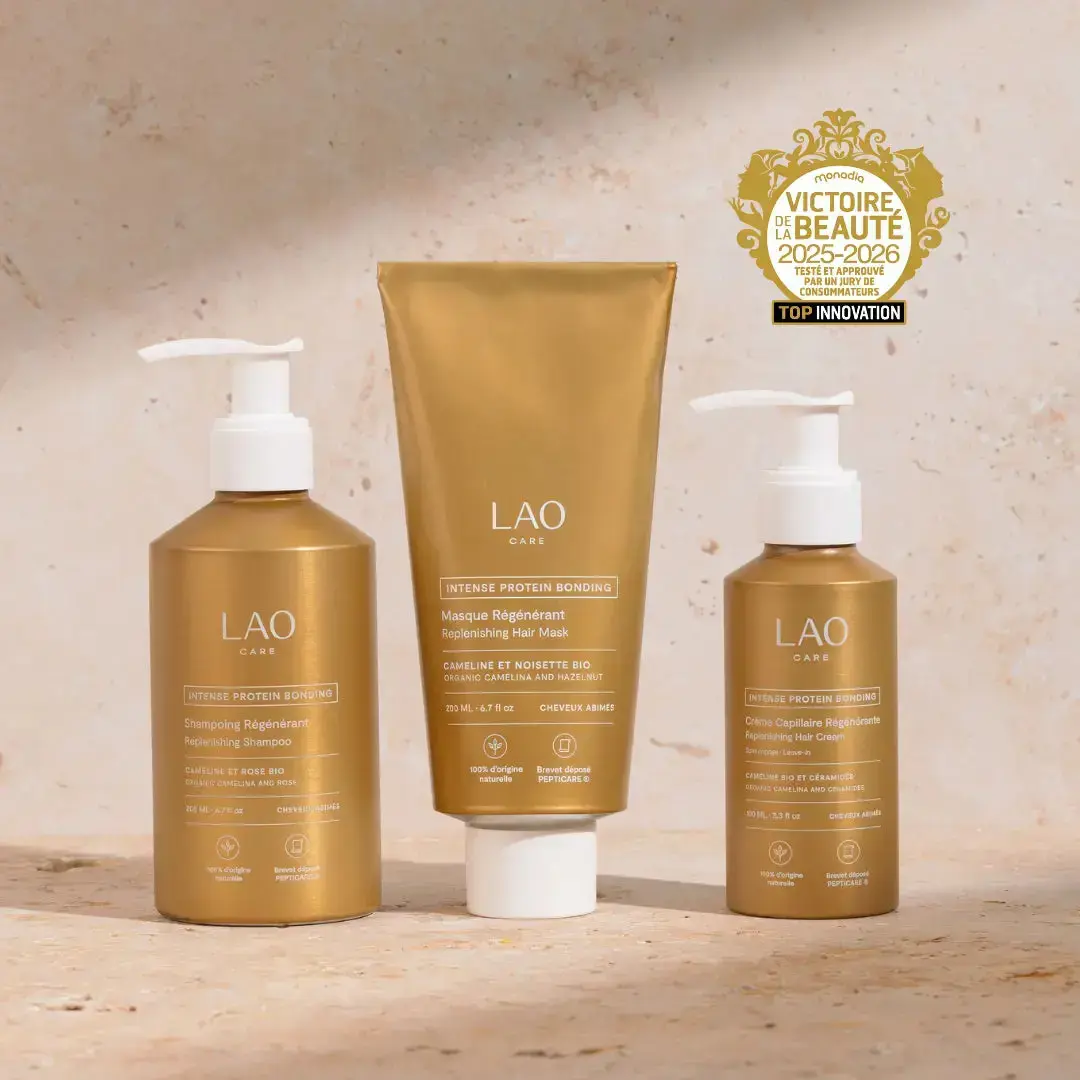


Having knots in your hair can be very unpleasant, and getting rid of them is often a hassle: you don’t always have the time, a comb or brush can hurt as it pulls through, and above all you may not know where to start… So how can we solve this problem without damaging hair that is already sensitized? LAO took a closer look at tangled hair and shares tips based on your hair type to help you undo knots as gently as possible.
First of all, why do we get knots in our hair?
We usually notice our knots when we wake up or after shampooing, sometimes after a busy day… Factors such as friction, wind or intense activity can all encourage knots to form.
Some hair types are more prone to everyday knots:
Dry hair, for example, is more affected by this problem: the strands rub against each other and tangle more easily than normal or oily-leaning hair.(1) That’s because sebum, the oily substance our body produces, notably in the sebaceous glands of the scalp, coats each hair and lets it “glide” past the others.(2)
In addition, the outer layer of our hair, the cuticles, can be slightly open and catch easily, and therefore tangle; damaged hair is also prone to this.(3)
We’ll come back to techniques for detangling knots in a way that respects the hair and keeps things gentle.
How to detangle curly hair?
To avoid damaging your curly hair, you can detangle it dry before washing, using your fingers or a wide-tooth comb, but this can turn out to be slow and not very pleasant.
We’d rather recommend gently detangling it when wet, even right in the shower, after a rich treatment such as a conditioner or a mask, which makes it easier for a comb or brush to glide through.
Depending on your preferences, don’t hesitate to try several styling tools, pin brushes, combs... to find the one that suits your routine best. You can also combine several.
How to detangle straight hair?
Detangling is slightly different for straight hair. This hair type can be more prone to breakage in the shower or afterwards, so it’s better to detangle beforehand, when it’s dry and therefore less fragile.
To limit breakage further, be careful to detangle your hair from the bottom up: the knots need to be worked out in stages, so comb a small section at the bottom of your hair and gradually detangle your way up toward the top of your head.
If a few knots remain after your shower, you can gently work them out without forcing once your hair has dried slightly, preferably after applying a product such as a treatment, an oil or similar.
What can you do to prevent knots in your hair?
There are a few techniques and tips to prevent knots, and LAO shares some of them with you:
- Brush your hair daily to bring the sebum down along your lengths
- Avoid overly frequent heat sources, which can dry out and weaken your hair
- Don’t rub your hair too much when shampooing, and focus on the roots rather than the lengths
- Apply treatments, preferably oil-rich ones, such as the LAO Care Nourishing Shampoo
- Sleep with a night cap, braids or other accessories that limit the movement of your hair, especially if you move around a lot
- Choose cotton, satin or silk accessories such as pillows, scrunchies, etc.
In conclusion, take care of yourself and your hair to limit knots, and don’t force it when detangling: there are several ways to go about it gently!
Sources
(1) https://www.ijtrichology.com/article.asp?issn=0974-7753;year=2014;volume=6;issue=1;spage=31;epage=33;aulast=Kumaresan(2) https://ufhealth.org/oily-hair
(3) Statement and explanation of the physical properties of hair: porosity, strength, plasticity, elasticity, … / https://sagascience.cnrs.fr/doschim/decouv/cheveux/voir_chim_chev_hum.html
Not sure which products are right for you? Discover your ideal routine in a few minutes.
Leave a comment