


Here is a topic that still gets very (too) little attention in the world of hair care products: the pH of your shampoo can make all the difference. Here is why.
Middle school refresher: what is pH?
The pH, or potential of hydrogen, is a parameter that tells us whether a medium is acidic or basic. In our case, the medium = the shampoo.
It is measured on a scale from 1 to 14 that is very easy to interpret: every value below 7 is "acidic," a value of 7 is "neutral," and anything above 7 is "basic."

But how does the pH of my shampoo affect my hair?
Understanding hair pH to choose a shampoo with the right pH
We won't dwell on this here, since it isn't the goal and we'll write a dedicated article, but here is everything you need to know to understand in simple terms how the structure of the hair is directly linked to the pH of your shampoo. A hair strand is made up of two parts: the follicle and the shaft.
The follicle of the hair is the part buried in the scalp. It is well known that the pH of the scalp is the same as that of the skin and hovers around 5.5.
The shaft of the hair, made up of about 95% keratin, is built from 3 layers, nested one inside the other:

The cuticle's job is to protect the inner structure of the hair: its cortex.
For the cuticle, which makes up the outer part of the hair shaft, to be healthy, its scales must be smooth, even and closely joined to limit friction between hairs (tangling) and give a silky look.
The pH of hair products, when suitable, can help keep the hair fiber healthy. On the other hand, an unsuitable pH will damage the cuticle, which can then no longer perform its protective function and will damage your hair.
Hair (and skin, for that matter) is covered with a thin film of sebum, lipids and water known as the "hydrolipidic film." You may have heard the term. It is also called the "acid mantle," and its job is to protect against bacteria and irritation.
Keratin, which makes up hair, is a protein that has the particularity of taking on a positive or negative charge depending on its environment. It reaches a neutral electrical charge when its pH reaches 3.67 (this is the isoelectric point).
To sum up simply: if the pH of the scalp is equal to 5.5, that of the shaft of the hair is much more acidic: 3.67.
When this pH is reached, the structure of the hair is well tightened and the scales are closed, smooth and joined. The hair is supple, soft and shiny, which allows sebum to spread normally.
Here are factors that can raise the pH of the hair and therefore damage it: relaxers, heat, mechanical treatments, use of alkaline solutions (hair color, perms)....
When the pH of the hair rises, the hair swells, becomes porous and weakened: the scales of the cuticle lift, and the hair tangles, looks dull and feels rough, and breaks more easily.
Let's get to the point!
If you made it through the scientific explanations, you will have understood that the physiological pH of the hair shaft is acidic and sits at around 3.67.
Keep in mind that every cosmetic product has a pH, and that this pH affects the cuticles of your hair, and therefore its health and beauty, for better (or worse).
This is why the pH of your shampoos and hair care products is vital.
According to the study we consulted, which is itself based on scientific literature, it was determined that a shampoo with a pH higher than 5.5 will increase hair friction and can damage hair, tangle it, create frizz and cause scalp irritation.
Moreover, shampoos with a pH above 8.5 (so very basic) can lead to scalp problems (eczema, dandruff, psoriasis, itching...).
Therefore, the ideal pH of your shampoo should be below 5.5 and as close as possible to 3.67 in order to neutralize the electrical charges.
You can correct the pH of a shampoo that doesn't meet these conditions by applying a more acidic conditioner. That is why it is very common to use vinegar as a spray, without rinsing after shampooing, to increase acidity!
For reference, the pH of children's shampoos is often closer to 7 because of their "no stinging eyes" claim, since this neutral pH is close to that of tears.
How can I find out the pH of my shampoo or hair care product?
Like the study this article is based on, we deplore the lack of transparency and information from brands about the pH of their products.
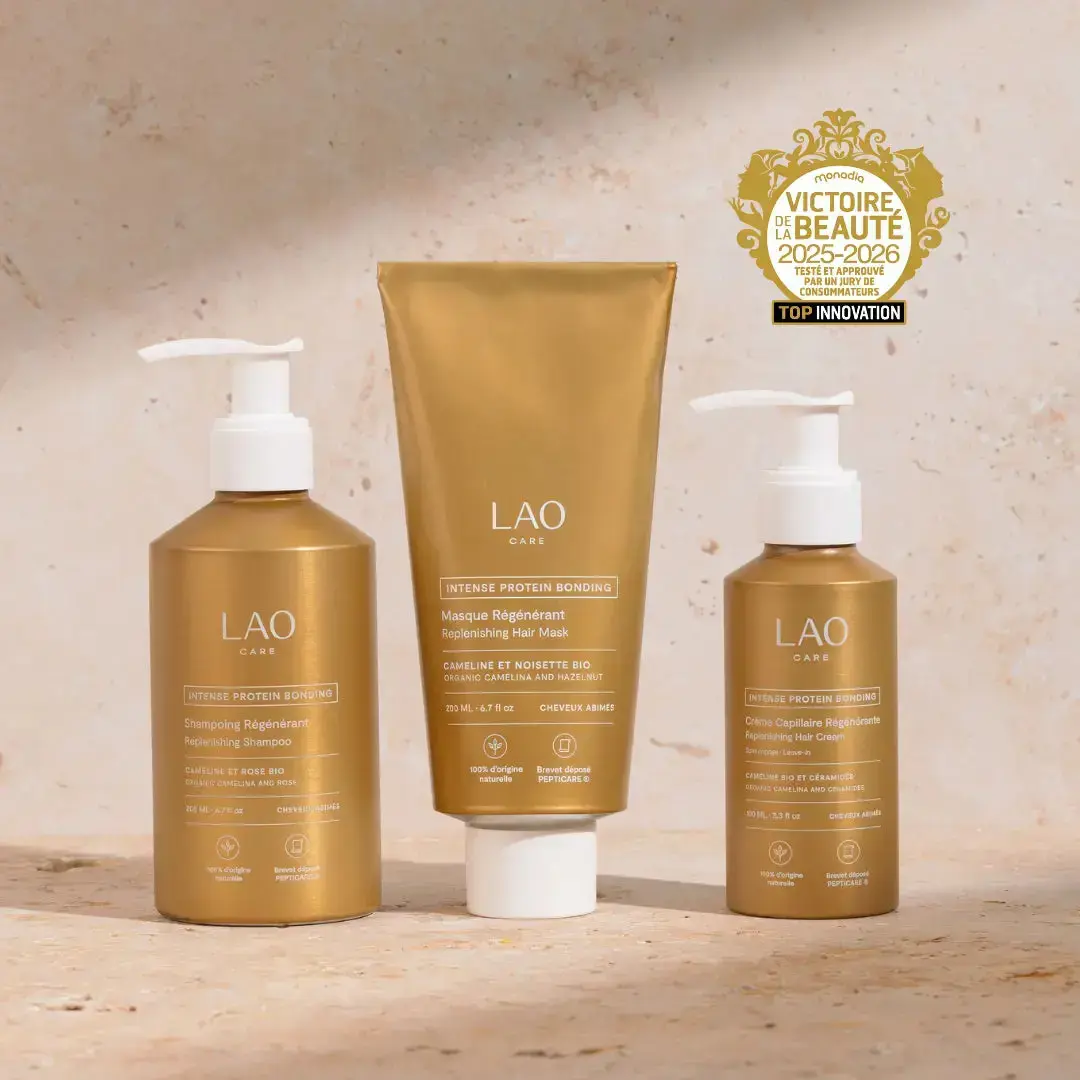
When developing our shampoo, we at LAO decided to show the pH directly on the bottle to make it easier for our customers to understand.
By taking a look at the INCI list of your shampoo or hair care product, you can however identify molecules used as pH adjusters that may indicate that the physiological pH of hair was taken into account in the formulation. Here are a few:
• acids
acetic, adipic, ascorbic, boric, citric, fumaric, glycolic, lactic, malic, uric…
• hydroxides
of ammonium, calcium, magnesium, potassium, sodium…
• phosphates
of ammonium, calcium, potassium, sodium…
• alkanolamines
Dimethyl MEA, Ethanolamine, Triethanolamine, Tromethamine…
Be careful, they are not all natural or harmless! But that's another debate.
Another way to find out the pH of your shampoos and hair care products is to use test strips made for this purpose. You can find them at pharmacies.
The case of solid shampoo
In the family of solid shampoos, there are two categories: those made with surfactants, and those made with soap. In soap formulas you may read "Sodium olivate," "sodium cocoate," "sodium castorate"... the word "sodium" indicates the saponification of various oils, here olive, coconut and castor. These are by definition basic, their pH is above 7 and far too high for the hair shaft! This is why many people who tried washing their hair with soap saw their hair become damaged and hard to detangle.
The scientific study (see the sources at the bottom of the article) explains that soap is an anionic detergent that, on contact with water, leaves an alkaline residue that is very bad for hair, in the form of calcium salt, which builds up in the hair, leaving it dull and tangled.
While using soap on the skin is not a problem because skin quickly rebuilds its hydrolipidic film, the same is not true of the shaft of your hair!
Conclusion
To conclude, understanding the very nature of hair helps guide our choice of suitable hair care cosmetics.
We therefore advise you to favor shampoos and hair care products with a pH below 5.5 and to avoid washing your hair with soaps, whose pH is too basic.
So, did this article teach you anything?
Sources
- pH. CNRS. Available online: https://www.cnrs.fr/cnrs-images/chimieaulycee/THEMES/acidite/ph.htm
-
Bushra T.AlQuadeiba, Eram K.D.Eltahira, Rana A.BanafabLama A.Al-Hadhairib. Pharmaceutical evaluation of different shampoo brands in local Saudi market. January 2018. Saudi Pharmaceutical Journal. Volume 26, issue 1. Pages 98-106. Available online: https://www.sciencedirect.com/science/article/pii/S131901641730172X
This study, carried out in Brazil in 2014 on more than 123 shampoos, also draws on the existing literature on the subject. It is fascinating!
- Maria Fernanda Reis Gavazzoni Dias,Andréia Munck de Almeida,Patricia Makino Rezende Cecato,Andre Ricardo Adriano,and Janine Pichler. The Shampoo pH can Affect the Hair: Myth or Reality? International Journal of Trichology. 2014 Jul-Sep; 6(3): 95–99. Available online: https://www.ncbi.nlm.nih.gov/pmc/articles/PMC4158629/
- C.E. OrfanosW. MontagnaG. Stüttgen. Hair Research: Status and Future Aspects. December 2012.
- pH regulator. CosmeticObs. 2011. Available online: https://cosmeticobs.com/fr/articles/lexique-cosmetique-5/regulateur-de-ph-864
1 comment
Bonjour, vos produits m’intéressent. Avant de faire un achat je voudrais avoir l’information du PH de vos shampoings , ce qui n’est pas précisé sur vos produits présentés en ligne.
Inférieur à 5,5 ?
Cordialement . Maryse
Leave a comment