
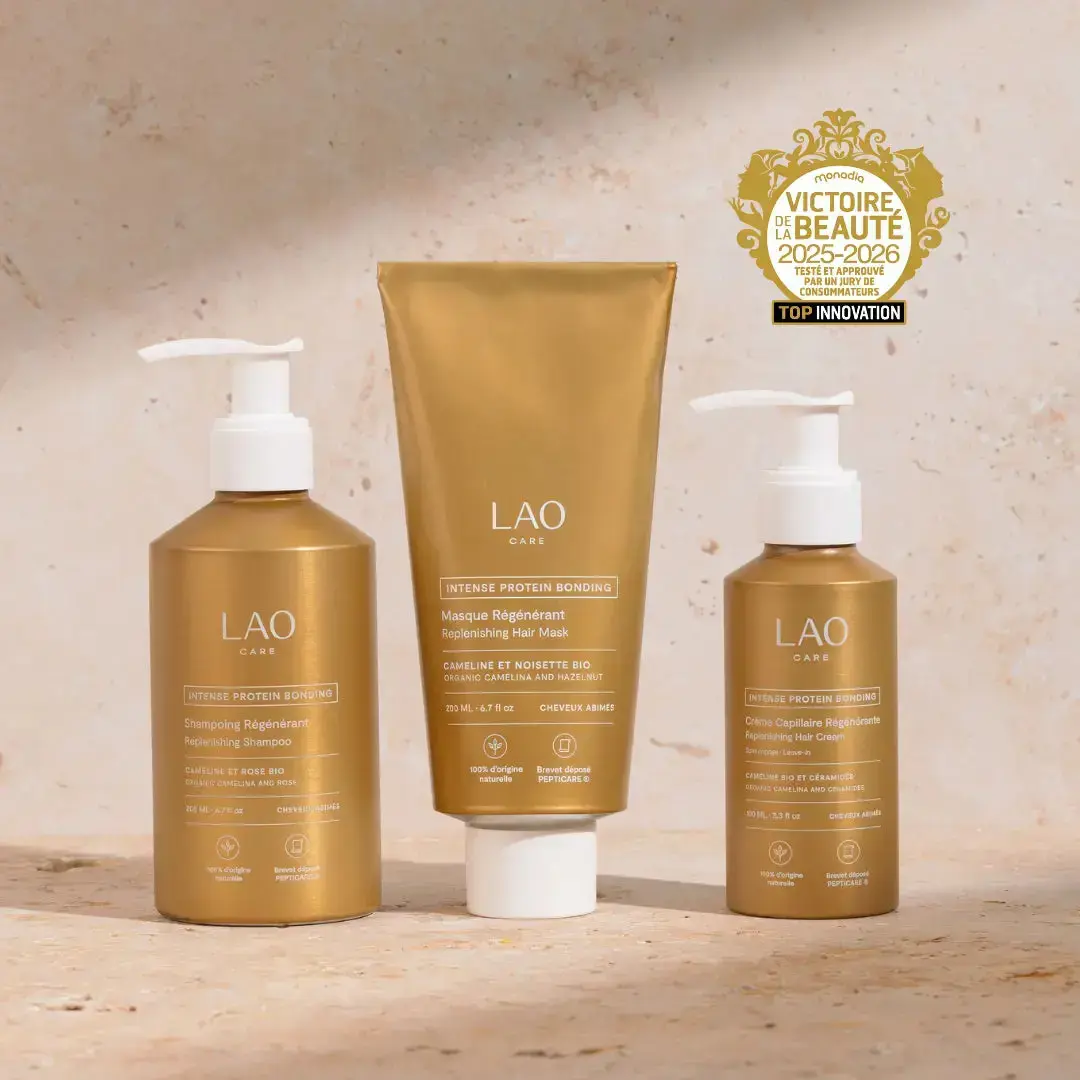


Often put to the test by various styling and transformation processes (temporary or permanent), your hair, and especially its lengths, has a hard life… and sometimes it shows! No wonder we so often complain about having dry, rough, damaged hair….
To at least partly remedy these very common problems, it's important to tell dry hair apart from nutrient-deprived hair. A dry strand needs water, while a nutrient-deprived strand needs nutrition.
Often mixed up, nutrition and moisture are in fact two different answers to two different hair problems. In this article, LAO explains what sets them apart and how to understand your hair's needs so you can care for it properly and naturally.
What is damaged hair?
After repeated use of heated tools, chemical coloring or bleaching, or perms, hair is weakened and loses vitality. You end up with dull, unhealthy hair that is dry or nutrient-deprived.
The ideal way to avoid damaging your hair in the first place is obviously to stop the problem at the source (goodbye perms, harsh (de)coloring and heated tools!). But for those who aren't ready to put their flat iron away in a drawer, there are other everyday habits to adopt!
When it comes to products, the one to change first, because it's the most used and the most important for your hair, is your shampoo. A chemical shampoo made with sulfates (stripping agents), silicones or quaterniums (film-forming agents) will only speed up the deterioration of your hair, whether it is dry or nutrient-deprived.
So favor a gentle, natural shampoo that cleanses without stripping too much of the layer of sebum your scalp and hair need to stay healthy. Sebum shouldn't be your enemy: it forms a necessary protective barrier (on the skin as well as on the scalp and hair).
Moisture: for dry hair
Repeated use of heated tools such as a flat iron, curling iron or hair dryer will damage the structure of your hair and dry it out. These tools alter the cuticle of the hair shaft, which causes its scales to open. Once they are open, the keratin is no longer protected and your hair will be less soft, less shiny and will hold water less well.
That's why the main problem with dry hair is its particularly high porosity. Picture the scales of your hair open like the spines of a hedgehog: water can get in, but it comes straight back out because the scales no longer close and no longer hold on to water.
So you need to change your whole hair routine before moving on to water-based care:
- Limit or even stop using heated tools (otherwise, apply a protective product beforehand)
- Sleep on a silk pillowcase to limit friction and damage to your hair
- Brush your hair gently, from the ends to the roots
Once you've adopted your new routine, you need to bring water back to your hair. This can start from the inside by drinking more (this kind of water intake won't work miracles on the lengths, though)!
As external care, we recommend aloe vera masks (very rich in water), for example.
At the beginning, to help your hair repair itself and close its scales, you can do an acidic rinse after your shower, with apple cider vinegar for example, as explained in this article. The acidity of vinegar is close to the pH of your hair shaft (pH = 4-5), so it will help seal in all the care you applied beforehand.
How can I tell if my hair is dry?
To find out whether your hair is dry, look at the appearance of dry hair: its high porosity. It's very easy to check your hair's porosity: just drop one of your hairs into a glass jar of clear water, as shown below:
 If your hair ends up at the bottom of the jar, then your hair is lacking water!
Nutrition: for nutrient-deprived hair
A hair that lacks nutrition is a fragile hair: brittle, with split ends. Chemical transformations of the hair such as coloring, bleaching and perms have reduced the amount of sebum in the scalp. Since sebum is the best natural nutrient for your hair, without it the hair is weakened and breaks.
Curly and thick hair often runs into this problem, by its very nature, because sebum has a hard time travelling down to the lengths. Combined with rough treatment, hair ends up extremely nutrient-deprived.
The first step to remedy this problem is to space out your shampoos (natural ones, as mentioned earlier); the goal is to let the hair rebuild itself with the amount of sebum it needs. You will also need to stop chemical treatments. (If you'd like to keep coloring your hair, consider plant-based color, which is less irritating and less stripping for your hair!)
Then you can use richer masks made with butters or plant oils. We recommend olive, hemp and mirabelle plum oils, among others, and oat butter. Easy to find and made in France, they are easy to add to your hair routine to care for your hair.
Once a week, you can do an oil bath, but be careful: this treatment is misnamed. It isn't a real bath, just a few drops spread over your lengths a few hours before your natural shampoo.
How can I tell if my hair lacks nutrition?
To find out whether your hair lacks nutrition, we'll look at one of the signs that characterize nutrient-deprived hair: split ends. To check, you can make two braids on either side of your head. You'll see little hairs sticking out of the braid; if you notice that they split at the tip into 2 or 3 branches, those are split ends. To remedy them, nothing beats cutting off the few damaged centimeters and caring for your lengths.

Leave a comment